Airborne Particle Analyzers
Airborne Particle Analyzers
- Sensitivity range: 200 nm to 10 µm
- Continuous particle-size channels
- Size each particle accurately
- Embedded pulse-height analyzer
- Real-time Class, PM2.5/10, and AQI
- Count specific particle sizes
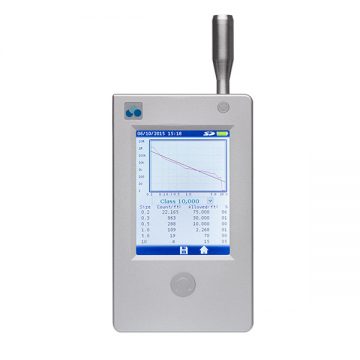
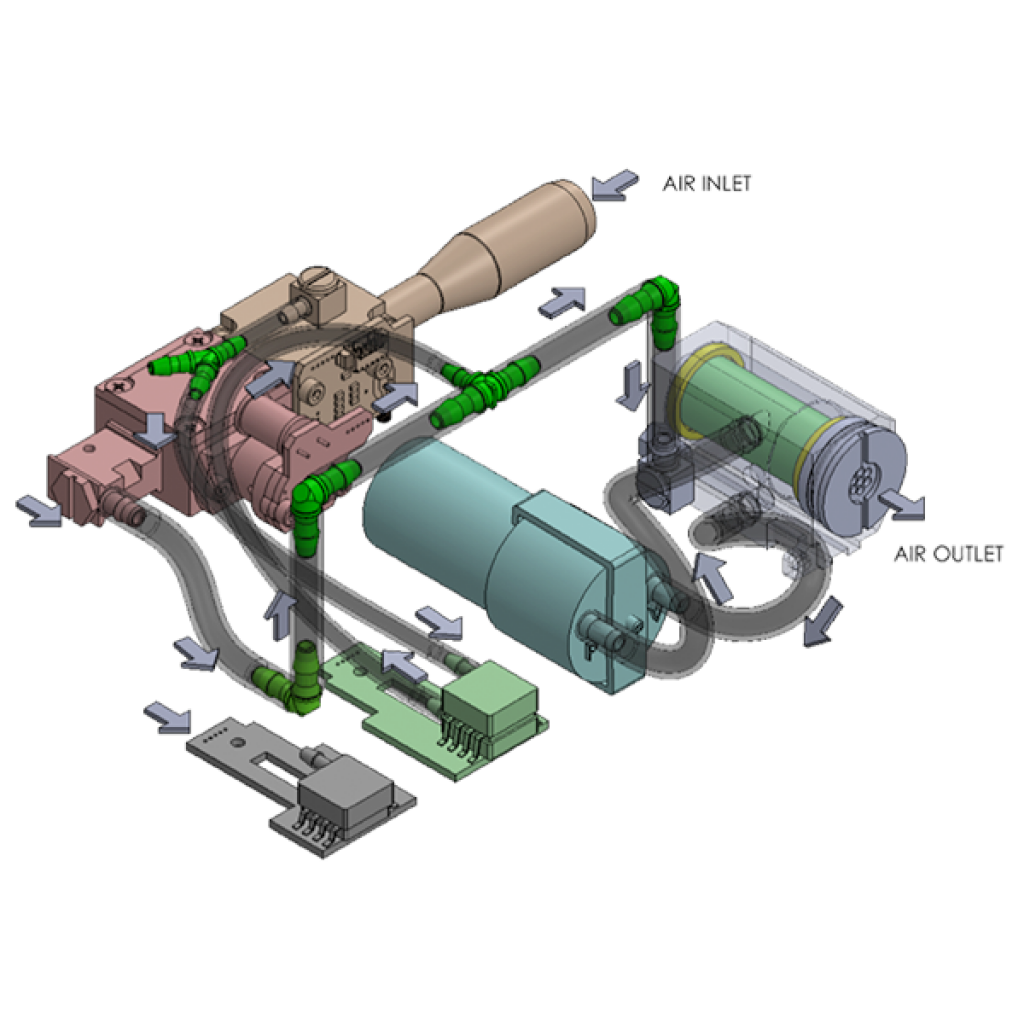
Teilch Particle Analyzers have proven significant advantages compared with competitors’ solutions. Innovations in light source, flow control, analog and digital signal processing, component integration, and software allow Teilch to provide a state-of-the-art system for precision particle analysis.
By acquiring a full, continuous particle-size spectrum, Teilch makes the concept of channels obsolete. A single stage of analog conditioning and digitization classifies particles in software rather than hardware, improving reliability and accuracy while providing true particle-size profiles.
TCH Pro 203
Continuous particle information
- Does your particle counter show the real environment? Are you really ISO compliant? Limited size channels hide vital information.
- Need to monitor a single size or set alerts for filter testing? An uncluttered display saves full data in the background for reporting.
- Record size data for every individual particle entering the sensor for post-analysis in Excel, MATLAB, or any numerical software package.
- Embedded pulse-height analyzer for advanced environment analysis.
- Display all common sizes on a single screen.
- Display particulate matter according to EPA standards for PM2.5 and PM10.
- Single-size reporting for advanced particle tracing. Users may set any size window with 10 nm resolution.
- Easy, intuitive configuration with all common units and standards built in.
Specifications
Model comparison
| Specification | TCH Lite 103 | TCH Pro 202 | TCH Pro 203 |
|---|---|---|---|
| Main uses | Air quality and filter monitoring in household, office, industrial, and healthcare environments | Cleanroom certification; air quality and filter monitoring in household, office, industrial, and healthcare environments | |
| Particle size range | 0.2 µm (50%) to 10 µm, continuous | ||
| Size channels | Unlimited number of channels. Capture size information for every individual particle. | ||
| Supported standards | ISO 21501-4 (instrument), US FED STD 209E, and ISO 14644-1 (cleanroom classification) | ||
| Sensor | High sensitivity, ultra-low noise, and fully compensated | ||
| Flow | 0.04 cfm | 0.1 cfm with internal flow meter (1% FS) and active flow control | |
| Light source | High-power, >10,000-hour laser diode with active control, full temperature compensation, and stabilization | ||
| Pressure | 115 kPa max, 5 Pa noise-free resolution | 115 kPa max, 1 Pa noise-free resolution | |
| Humidity | 5% to 95%, ±2% — external ambient sensor | 5% to 95%, ±2% — internal flow sensor | 5% to 95%, ±2% — external ambient sensor |
| Temperature | 0–50°C, ±0.1°C — external ambient sensor | 0–50°C, ±0.1°C — internal flow sensor | 0–50°C, ±0.1°C — external ambient sensor |
| Display | 3.5-inch color LCD | ||
| Operating method | Touchscreen and single button | ||
| Battery | Li-Ion, 9 hr continuous counting, 15 hr intermittent counting | User-replaceable Li-Ion, 5 hr continuous counting, 10 hr intermittent counting | |
| Storage | 64 MB internal | External SD card | 64 MB internal and external SD card |
| Connection | USB (removable disk) | USB (removable disk), SD card | USB (removable disk), SD card |
| Dimensions | 74(W) × 100(H) × 30(D) mm | 82(W) × 137(H) × 42(D) mm | 82(W) × 137(H) × 42(D) mm |
Interface and analysis
Information that supports better decisions
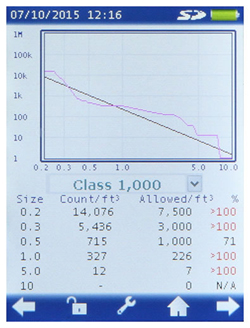
Does your particle counter show the real environment? Are you really ISO compliant? Limited size channels hide vital information.
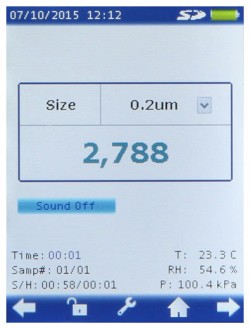
Monitor a single size or set alerts for filter testing, while full data is saved in the background for reporting.
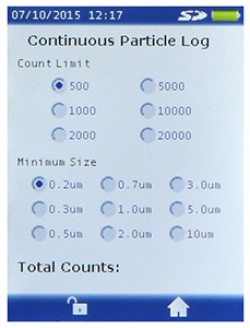
Record size data for every particle that enters the sensor for post-analysis in Excel, MATLAB, or numerical software.
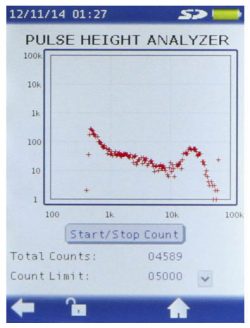
Use the embedded pulse-height analyzer for advanced environmental analysis.
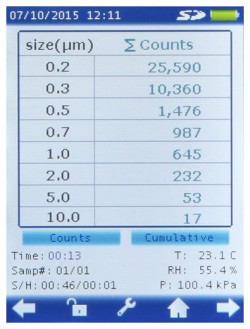
Display common particle sizes together on a single clear screen.
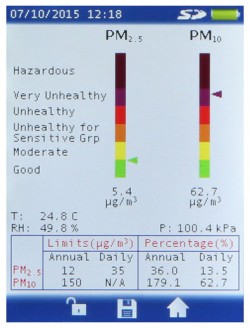
Display particulate matter to EPA standards for PM2.5 and PM10.
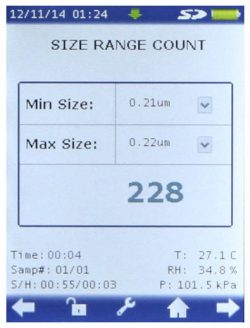
Trace a specific particle-size window with 10 nm resolution.
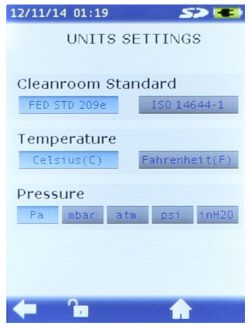
Configure quickly with common units and standards built in.
Particle measurement fundamentals
The air you breathe
A practical introduction to airborne particles, why they matter, and how particle analyzers turn them into useful information.
Particle matter
What do we breathe?
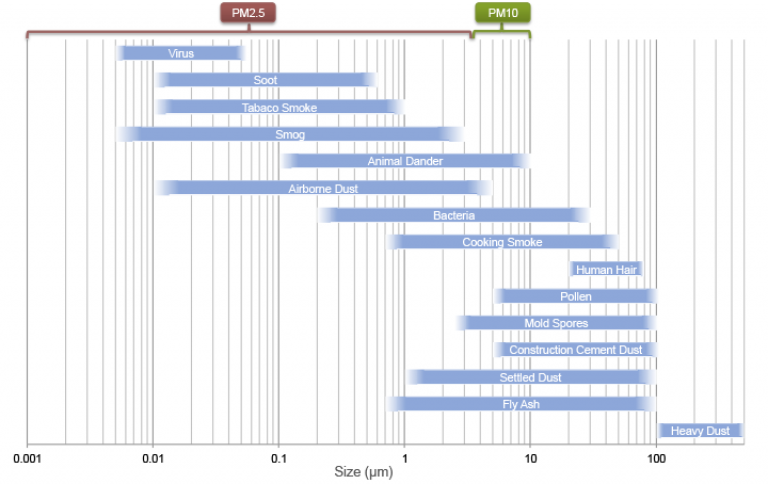
Particles, or particulate matter (PM), are subdivisions of solid matter that surround us. PM comes in many shapes and sizes and can be solid particles or liquid droplets. It is everywhere: in the atmosphere, at ground level, and even in our homes.
PM floats through the air and, with every breath we take, we breathe it in—even when most of it is not visible to the naked eye.
Particle monitoring
Why monitor particles?
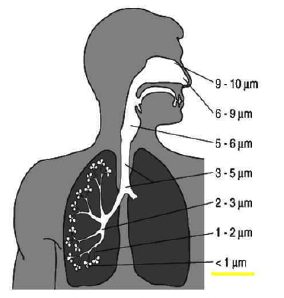
Although too small to see, PM is the air pollution that most commonly affects people’s health. Depending on their size, particles are a leading cause of respiratory and cardiovascular problems. When a person inhales, air contains visible and microscopic particles that can enter through the nose and mouth.
Depending on their size and composition, particles can travel deep into the respiratory system and may be more toxic. Particles smaller than 1 µm are likely to reach the peripheral airways and alveoli or be exhaled; particles from 1–5 µm deposit in the large and conducting airways; and particles larger than 5 µm predominantly deposit in the oropharynx. Effects include asthma, lung cancer, birth defects, and premature death. PM pollution causes around 200,000 deaths per year in Europe.
For example, a person breathes an average of 11,000 litres of air per day. The breakdown of particles breathed per day by particle size is as follows:
| Particle size (µm) | Particles breathed per day |
|---|---|
| 0.1 | 11,000,000,000 |
| 0.2 | 2,607,000,000 |
| 0.5 | 387,200,000 |
Scale
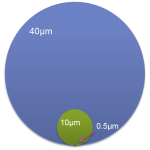
How big is a micron?
Forty microns are the smallest particles that can be seen by the human eye.
Measurement principle
How do particle analyzers work?
A particle counter is an instrument that detects and counts particles. It works on the principle of light scattering, light blocking, or condensation to detect and measure particle size or size distribution. When a particle is illuminated by a light beam, it is redirected (light scattering) or absorbed (obstruction).
The redirected or lost light, depending on the method used, is detected by a photodetector, measured, and the particle is counted and tabulated into standardized counting bins. If direct imaging is used, a halogen light illuminates particles from the back within a cell while a high-definition, high-magnification camera records passing particles. The recorded video is then analyzed by computer software to measure particle attributes.
Sensor anatomy
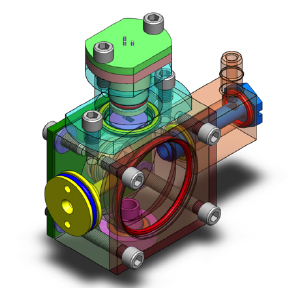
A particle counter is made up of the following components:
- Light source (bright laser light)
- Reflector
- Light sensor
- Electronic signal-processing circuit